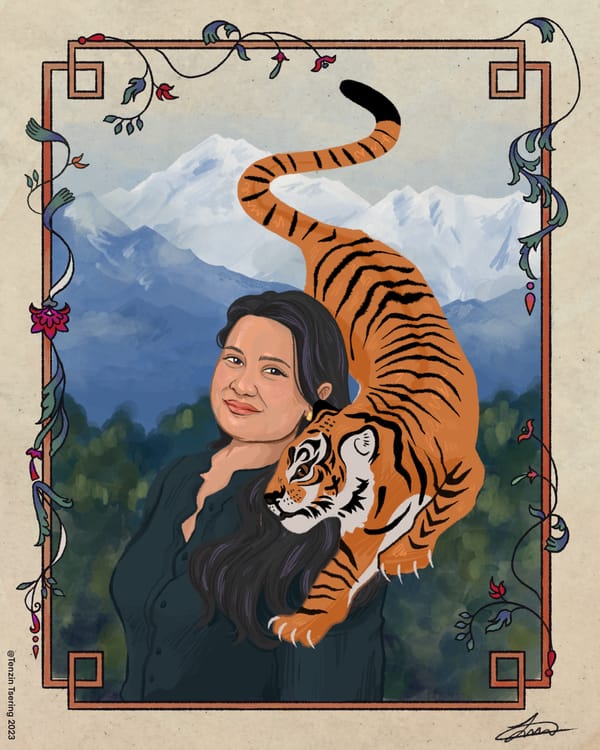
Happy Losar! ལོ་གསར་བཀྲ་ཤིས་བདེ་ལེགས།

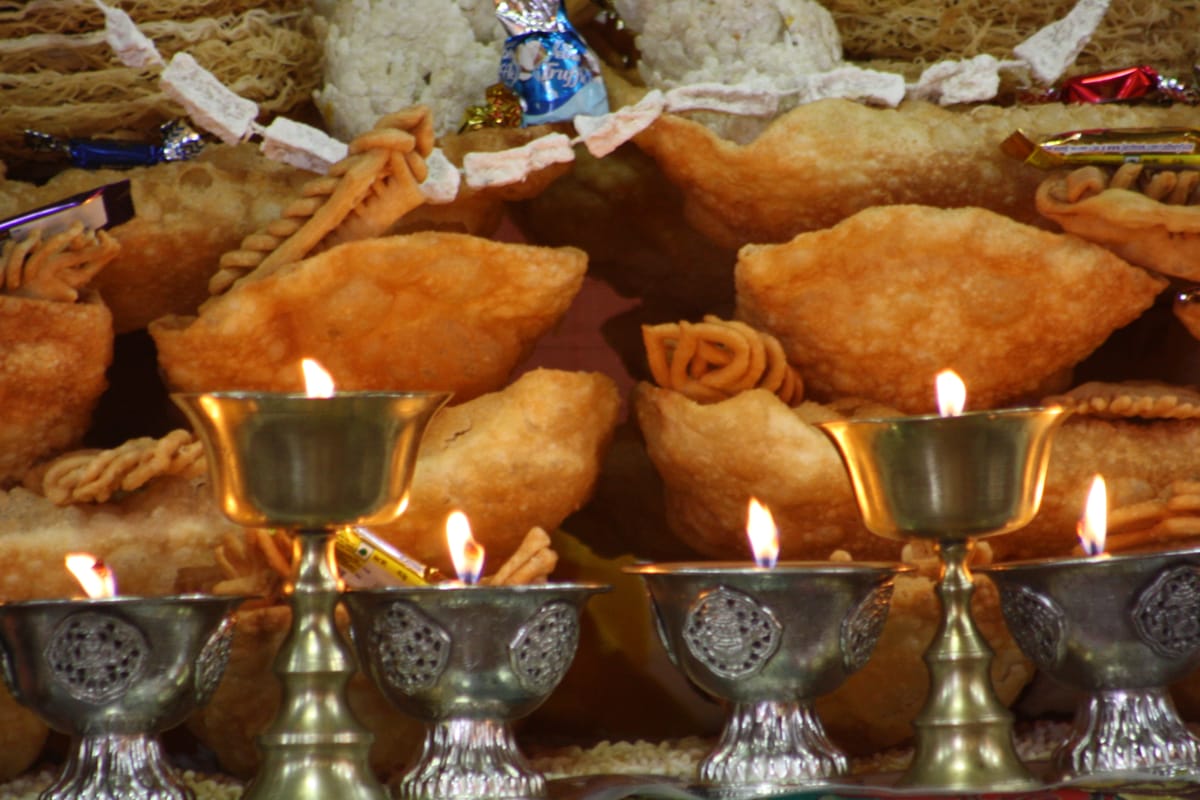
Losar, the Tibetan New Year, feels particularly poignant to me this year, as I celebrate with my family and friends, many of whom came as refugees to this land. They are descendants of (or themselves) Tibetans who followed His Holiness the Dalai Lama into exile in 1959 when China invaded Tibet. There are an estimated 150,000 Tibetan refugees around the world. In 1990, the U.S. authorized a one-time lottery system for 1,000 displaced Tibetans to immigrate here, and that Immigration Act of 1990 eventually allowed many more to migrate to the U.S. and seek citizenship through political asylum.
As a Bhutia woman from the northeast Indian state of Sikkim, I did not face any of the tribulations that Tibetans do as refugees, among whom are my own incomparable root teacher, and so many of the great lamas and lineage holders of Buddhism. I was brought to the United States by my aunt and completed high school in New York City along with my cousin. I went to college in Ohio, surrounded by cornfields and professors who encouraged my independence every step of the way. I had warm and caring host parents, dairy farmers who were invested in land conservation, and who voted Republican. I completed my Master’s in Washington D.C., where I learned to become a critical thinker and navigate bipartisan politics, and I went on to work in some of the best-known environmental organizations in the United States. And, eventually, I settled down and became a naturalized citizen. My immigration story was not easy but it was not hard compared to my Tibetan friends and community members whose human dignity is called into question for simply having once been stateless. When the truth is we all belong to this Earth in equal measure and no-one has the right to decide that any of us are homeless and therefore, of lesser value.
Being a Tibetan Buddhist in America feels very strange right now. There is a painful kind of karmic recognition to see that Tibetan refugees who fled an overtly authoritarian and fascist regime, and were invited into the United States which prized democracy and human rights, are now faced once again with the rise of authoritarianism, the erosion of human rights, and the threat of dispossession and displacement. This is the truth for all refugee communities in the United States, so many of whom are here because they were persecuted in their home countries for standing with America.
Some of you might ask why I chose to stay when I could have returned to Sikkim at any point to live a comfortable life. Why? Because I fell in love with this young and brash nation, which also happens to be one of the oldest democracies in the world. My love for America springs from the enshrinement of constitutional freedom, specifically, the First Amendment, which protects our rights to hold our religious beliefs, to speak out as we think fit, and to voice our grievances without fear of retribution or suppression. The First Amendment protects five key freedoms:
- Freedom of Religion
- Freedom of Speech
- Freedom of the Press
- Freedom to Assemble
- Freedom to Petition
Without the First Amendment, I could never have dreamed of the mission of the various faith-based initiatives I have created: the latest being the Loka Initiative. The mission of all of these initiatives has been to be a bridge between Religion and Science, to support faith leaders and culture keepers of Indigenous traditions on environmental and climate protection, and to bring together people that are vastly different in their beliefs and norms, and even their voting patterns, but united in their concern for who and what must be protected.
The First Amendment goes beyond politics. It gets into the heart of our values and who we are as a nation and what we dream of for our collective future. What does it mean then when our government flagrantly disregards it and our constitutional rights? What does it mean when those who have been entrusted with representative power tell us in their own words that because we dissent, our lives are expendable, that immigrants are vicious criminals, that the only worthy people on this land are white supremacists? It means we must take them seriously.
Working with faith leaders around the world for almost 20 years, I have learned to trust those who draw upon their spiritual values to stand against oppression and injustice of all kinds. At this moment in time when it is easy to feel like we are drowning, I am buoyed by faith leaders in Wisconsin who welcome immigrants into their houses of worship and see them as vital for their ministry. They remind us that 86% of immigrants arrested by ICE have no criminal convictions and of those who do, mainly consist of minor offenses. In a time when it is easy to feel numb, I am deeply moved by faith leaders who gathered from all over in Minnesota to stand together against federal violence. In a time when it is easy to curl inwards, I feel indebted to faith leaders who kneel in prayer even while under physical attack for suffusing me with moral courage.
This Losar, we welcome the Year of the Fire Horse, an astrological year that is known to be a catalyst for rapid societal change. Whether a prophecy or a metaphor, the fire horse symbolizes accelerated energy and cleansing momentum, and feels particularly momentous given the current global and national climate where we are surrounded by increasingly violent rhetoric and action, geopolitical conflict, economic instability, and climate disasters. As a Tibetan Buddhist, what I do know is that regardless of the astrological significance, we are now living in a time when we must mindfully commit to cultivating compassion and courage in equal amounts. As a person of faith, I naturally turn to my own teachers whose wisdom guides me through this turbulent journey.
It is worth noting that every successful civil rights movement has, at their core, had faith leaders organizing and mobilizing their communities to act according to their spiritual morals and values. Right now, when the First Amendment is under attack, and our freedom of religion, our freedom of speech, the freedom of press, our right to assemble, and our right to protest is under threat, we cannot be quiescent. When faith leaders rise en masse in the way they have, we must rise alongside them.